
Depolarization as Relational Design in Cities: Insights from a Six-Year Urban Living Lab
13th June 2026 – Findings from the OurCluj Values-Based Urban Living Lab were presented at the 2026 Mind & Life Summer Research Institute in New York, a global gathering of researchers and practitioners exploring contemplative science, social connection, and collective flourishing.
The poster shared insights from a six-year transdisciplinary inquiry into how trust, care, and relational capacity can be intentionally cultivated in cities.
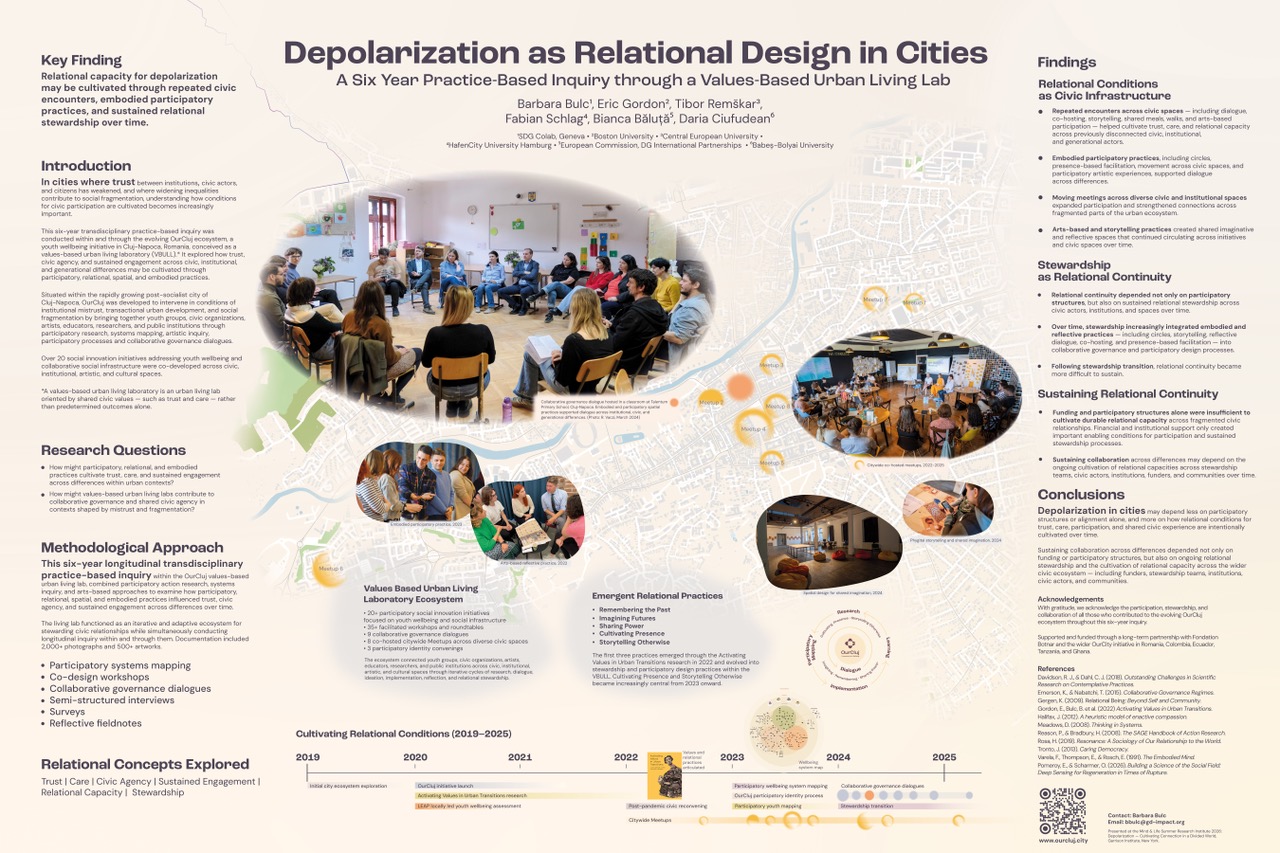
This research contributed to the theme “Depolarization: Cultivating Connection in a Divided World.” The Institute builds on a pioneering dialogue between the Dalai Lama and scientists that began in 1987 and and has since become a leading space for inquiry into the relationship between mind, society, and collective flourishing.
While much depolarization research focuses on individual attitudes or short-term interventions, this inquiry explored how cities can cultivate the long-term relational conditions that enable trust and care to grow across differences.
Key Findings
Relational capacity for depolarization can be intentionally cultivated. Rather than resulting from isolated interventions, depolarization emerges through civic infrastructure that enables relationship-building. When repeated encounters, embodied and participatory practices, collaborative governance, and stewardship are sustained over time, trust and care can be cultivated across differences, supporting collective flourishing.
Research Highlights
- Six-year transdisciplinary practice-based inquiry in Cluj-Napoca, Romania
- Values-Based Urban Living Lab focused on youth wellbeing and collective flourishing
- More than 20 initiatives and experiments involving young people, educators, civic organizations, public institutions, entrepreneurs, and researchers
- Participatory mapping, governance dialogues, civic imagination, and arts-based practices
- Exploration of trust, care, and relationship-building as foundations for urban transformation
- Contribution to emerging research on depolarization, civic life, and collective flourishing
Authors
Authors: Barbara Bulc, Eric Gordon, Tibor Remškar, Fabian Schlag, Bianca Băluță, and Daria Ciufudean. Presented by Barbara Bulc. This research builds on the study “Activating Values in Urban Transitions” (2022), developed in collaboration with SDG Colab, Professor Eric Gordon, and the ArtiViStory Collective.
Acknowledgements
This work reflects the contributions of hundreds of participants across Cluj-Napoca over six years, including young people, educators, civic organizations, cultural institutions, researchers, entrepreneurs, and public servants. We are grateful to Fondation Botnar for its long-term trust and support, and to all local and international partners who helped shape this ongoing inquiry into trust, care, and wellbeing in cities.
New study examines the benefits of prioritizing well-being over
economic growth in urban innovation
29th June 2022 – Today, SDG CoLab, the Engagement Lab @ Emerson College, the Massachusetts Institute of Technology, and the ArtiVistory Collective, with funding from Fondation Botnar, have released the new study “Activating Values in Urban Transitions: A novel approach to urban innovation in Romania.”
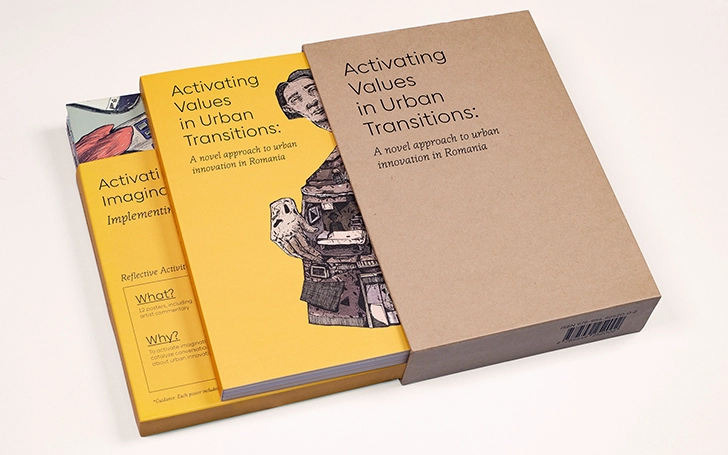
The study finds that the explicit articulation of values of care and trust is essential for creating and sustaining local innovation ecosystems in the Eastern European context. It details how the foregrounding of these values is accomplished, and it provides design recommendations for other cities interested in reproducing the model in the pursuit of just transitions and well-being.
Published during the World Urban Forum (WUF11), the premier global conference of sustainable urbanization taking place in Katowice, Poland, the research examines the innovation culture in Cluj-Napoca, Romania, a vibrant and rapidly growing intermediary city in Eastern Europe.
The study documents the co-creation of OurCluj, a multi-sectoral, multi-disciplinary living laboratory focused on well-being. Traditionally, living laboratories are innovation clusters, housed within city government, that seek to address policy issues such as housing, education, etc. OurCluj is different because its goal is not progress on a single policy, but on the values that guide innovation itself. Prioritizing these values is a requirement for creating policies and programs that are optimized for outcomes such as enhanced well-being of the city’s young residents.
As the study describes, such novel arrangement is called a “Values-Based Urban Living Laboratory” or VBULL. It comprises three primary activities that drive values-forward innovation: imagining futures, reconciling the past, and sharing power. The research unpacks each of these activities and examines how they contribute to urban innovation culture that is both unique to the Eastern European context and potentially applicable to cities in other regions. The study concludes with 10 design recommendations for practitioners to catalyze VBULL in their spaces. It is complemented with a reflective activity with full-colored artistic posters to imagine alternative frames for urban innovation and communities.
At the recent launch of the study in Cluj-Napoca Mayor Emil Boc remarked: “This contribution is an excellent and visionary work; it is offering us light in some aspects we need and it is going to be part of the city strategy.”
Susanna Hausmann, Fondation Botnar’s Chief Program Officer, said: “The values are the pillars for building resilient cities and societies where the citizens, including young people, can experience well-being.”
The research was led by Prof. Eric Gordon, Emerson College and the Massachusetts Institute of Technology, in collaboration with Barbara Bulc, primary steward of OurCluj and founder of SDG CoLab. Visual art plays a central role in the study, not just as visualization, but as a part of the methodology. Each interview was conducted by a researcher, with a team of artists documenting the affective dimensions of the conversation. Follow-up interviews asked people to reflect on the visual representations, effectively uncovering the emotional dimensions of innovation. The publication was designed by Studio Punkt.
This study is a timely contribution to the central theme of WUF 11, Transforming Our Cities for a Better Urban Future. It highlights the role of intermediary cities, which are today at the forefront of forging transformative pathways in post COVID-19 recovery, when nearly every assumption about urban growth is being questioned. The research supports the Fondation Botnar’s OurCity initiative in several intermediary cities accros Europe, Africa, Latin America and Asia.
Media opportunities:
For interview opportunities, please contact: info@sdg-colab.org
Telephone: +41 79 263 9627
SDG Colab, Geneva, Switzerland www.sdg-colab.org
About the study:
Read or download the study: www.ourcluj.city
About SDG Colab
SDG Colab is a non-profit collaboratory focused on design and research of alternative collaborative structures for the well-being of people and the planet. Based in Geneva, Switzerland and engaged globally, it was founded by Barbara Bulc to reimagine values and relationships, essential to shift the current economic paradigm.
For more information, visit: https://sdg-colab.org.
About Engagement Lab @ Emerson College
The Engagement Lab @ Emerson College is a research and design lab focused on collaborative design of civic life. Founded in 2012, the Engagement Lab has focused on urban innovation and has worked in cities around the world to collaboratively create tools to facilitate democratic processes.
For more information, visit: http://elab.emerson.edu
About MIT Civic Design
The MIT Civic Design Initiative actively imagines democratic futures – including institutions, processes and spaces — as technologically enhanced and human-centered. The Civic Design Initiative is a research group in Comparative Media Studies and Writing Department at MIT that aims to offer a unique place and platform to support new and continuing research that address one or more of the complex civic challenges we face today.
For more information, visit: http://civicdesign.mit.edu
About ArtiViStory Collective
ArtiViStory Collective is a community of young local artists and faculty members from the Faculty of Fine Arts of the University of Art and Design in Cluj-Napoca, Romania. Incubated during the design process of the OurCluj VBULL, the ArtiViStory Collective engages with urban comics and graphic narratives to catalyze learning and social innovation in urban settings.
For more information, visit: www.uad.ro
About Fondation Botnar
Fondation Botnar is a Swiss philanthropic foundation working to improve the health and wellbeing of young people living in cities around the world. Advocating for the inclusion of youth voices and the equitable use of Artificial Intelligence and digital technology, the foundation invests in and supports innovative programs and research and brings together actors from across sectors to create dialogue and partnerships.
For more information, visit: www.fondationbotnar.org

Funded by Fondation Botnar
Fondation Botnar is a Swiss foundation focused on improving the health and well-being of young people in growing urban environments around the world. OurCity is an initiative by Fondation Botnar which enables cities around the world to implement coordinated programs that leverage digital technologies and AI to transform them into places where young people’s voices and needs are recognized and prioritized.